
Colloidal Gold Conjugation
What it is
Conjugation is the process of attaching detection antibodies to colloidal gold nanoparticles (typically ~40 nm), producing the colored label that makes the test line visible.
How it works
Gold nanoparticles are synthesized and then passively adsorb antibodies via electrostatic and hydrophobic interaction; the conjugate is stabilized, blocked and dispensed onto the conjugate pad. Batch-to-batch control of particle size and antibody density determines signal intensity and consistency.
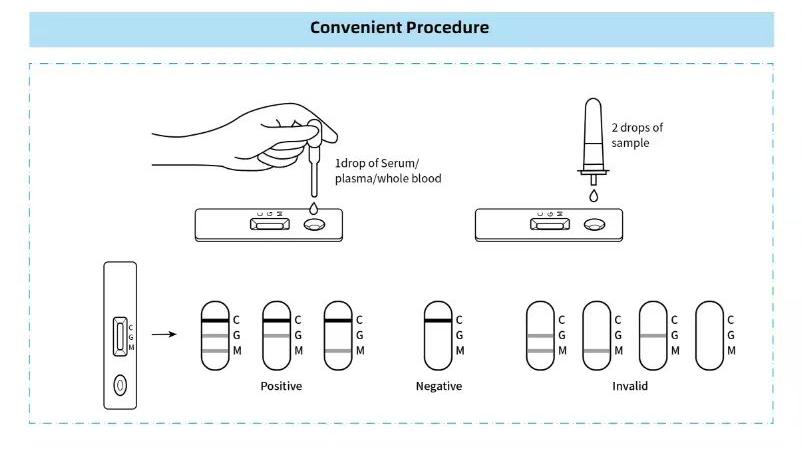
Why it matters
Conjugate quality directly affects sensitivity and the clarity of the result line — a key QC point and a common source of batch variation that buyers should ask about.
Key components
- Gold nanoparticle synthesis (uniform ~40 nm)
- Antibody adsorption (passive conjugation)
- Stabilization and blocking
- Conjugate pad dispensing and drying
Applications
- Detection-antibody labeling for lateral-flow tests
- Antigen labeling for capture formats
- Signal generation in sandwich and competitive assays
What affects performance
- Antibody concentration and pH during conjugation
- Particle size and uniformity
- Blocking to prevent aggregation
- Conjugate stability over storage
Limitations
- Conjugate aggregation reduces reproducibility
- Over- or under-loading changes signal intensity
- Conjugation conditions are antibody-dependent
Frequently Asked Questions
What is colloidal gold conjugation? Attaching antibodies to gold nanoparticles so they serve as the visible detection label in a lateral-flow test.
Why does conjugation quality matter? It determines signal intensity, line clarity and batch-to-batch consistency.
What affects conjugation? Antibody concentration, pH, particle size and blocking all affect conjugate stability and performance.
Related knowledge
References
- Posthuma-Trumpie GA, Korf J, van Amerongen A. Lateral flow (immuno)assay: its strengths, weaknesses, opportunities and threats. Anal Bioanal Chem. 2009;393(2):569-582.
- Koczula KM, Gallotta A. Lateral flow assays. Essays Biochem. 2016;60(1):111-120.
- Bahadır EB, Sezgintürk MK. Lateral flow assays: principles, designs and labels. TrAC Trends Anal Chem. 2016;82:286-306.
- 侧向层析标记物研究进展 (Research advance of lateral flow assay labels). Journal of Biomedical Engineering. PMC9935128.
See this technology in our products → Browse catalog
Written by the Progene Bio Technical Team · Last reviewed: 2026-09-12